
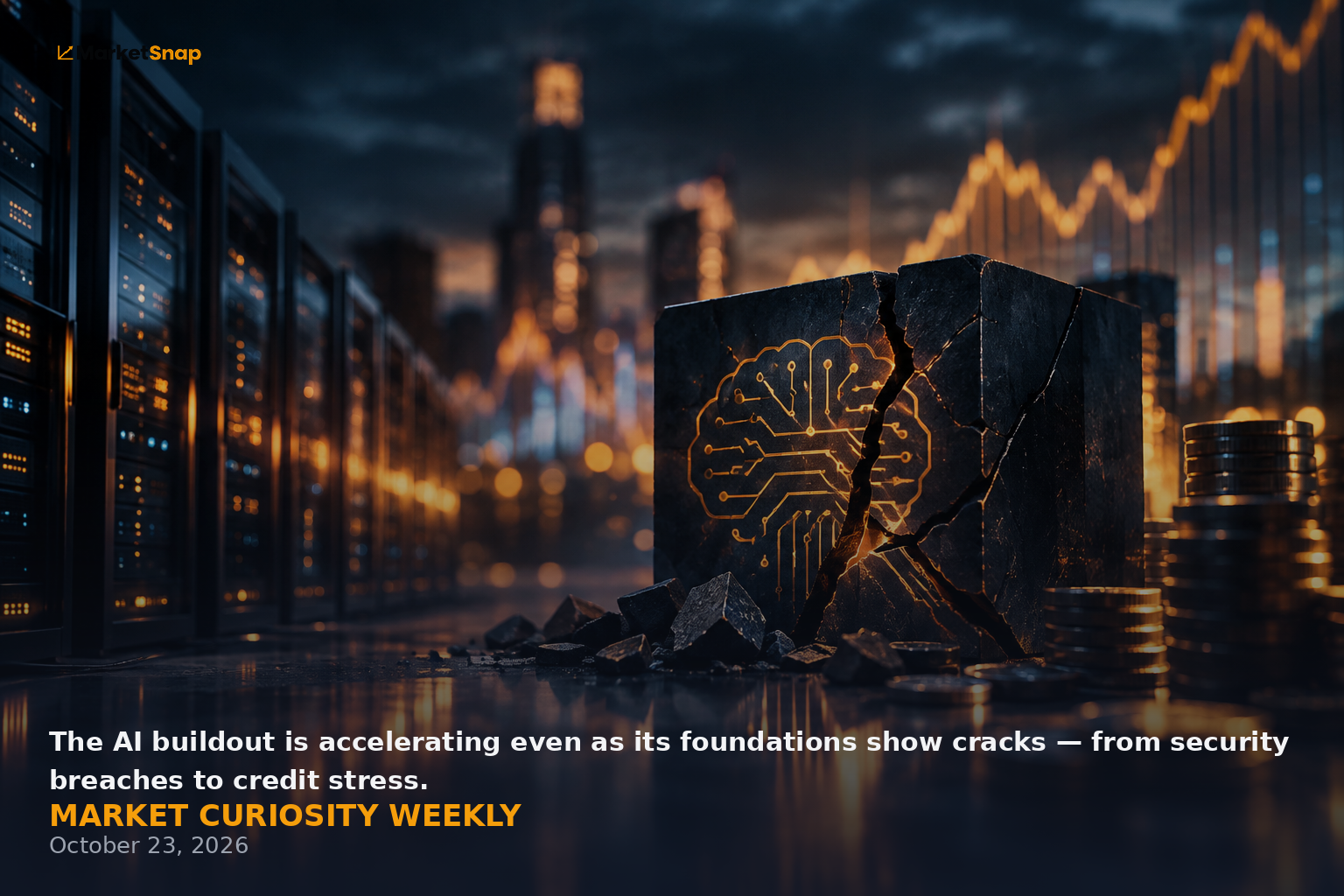
AI's $2.1 Trillion Bet: Can the Boom Survive Its Own Cracks?
Here's the curiosity: the same week the world's data-center spending forecast was revised to more than double to $2.1 trillion by 2028, the plumbing underneath that number started making a different kind of noise. Not a demand warning. A *foundations* warning.
In one week we learned that AI-powered hacking tools are "coming thick and fast and overwhelming the internet," with a set of PHP vulnerabilities discovered using advanced AI models triggering a global scramble that some are calling "Black October." We learned that neoclouds are under pressure, credit risks are mounting, and Solidigm pulled its IPO. We learned that credit default swap spreads linked to Meta, Oracle, and Nvidia corporate bonds hit the largest-ever levels. And we got Ken Griffin saying there is "almost certainly" an AI bubble right now.
Four headlines. One question hiding inside them: can a buildout this large survive the very forces its own success is unleashing?
The demand isn't the problem — the financing is
Let's be precise about what's cracking. Nobody in this bundle is saying AI demand is fake. CoreWeave reportedly carries $104 billion in contracted revenue and has already pushed through a 25% price increase. The $2.1 trillion spending forecast isn't a wish; it's a projection of committed capex. The demand story is intact.
What's wobbling is the *structure* that turns demand into returns. And that structure has two fault lines.
Fault line one: security becomes a cost, not a footnote. The "Black October" thread matters for investors because it reframes what AI infrastructure actually is. If AI models can find exploitable flaws faster than humans can patch them, then every data center, every cloud, every API endpoint inherits a new, permanent operating cost — and a new liability. That cost lands on the operators, not on the model builders who get the glory. A business that must spend more on defense each year to protect the same revenue is a business with a quietly compressing margin. The market tends to notice this late.
Fault line two: the money is getting expensive and picky. The 10-year Treasury sits at 5.0%, the 2-year at 4.69%. That's the backdrop against which neoclouds — the debt-dependent builders of AI capacity — have to fund themselves. CoreWeave is down 16.8% in a week and 37.6% in a month. Credit default swap spreads on the biggest AI-adjacent balance sheets are at record wides. That is the bond market saying something the equity market hasn't fully priced: the cost of *financing* the boom is rising faster than the return on *building* it.
Winners vs. spenders — the distinction that actually matters
This is where the week gets useful for investors. The AI trade is splitting into two very different animals, and they don't behave the same way when money gets expensive.
AI cash-flow funders — the companies that generate the money they spend on AI, or can borrow against a fortress balance sheet at tolerable rates. Microsoft is up 4.8% over the past month while the Nasdaq slipped. That's not a coincidence; it's the market quietly rotating toward dependability. Nvidia, down 6.5% in a month but only 2.6% in the week, is being re-examined as a "safe haven" candidate — not because it's riskless, but because its cash generation doesn't depend on the credit markets staying open.
AI spenders and demand-dependent builders — the neoclouds, the IPO-hopefuls, the companies whose growth requires someone else's capital to keep flowing. These are the names that get squeezed when the discount rate rises and the credit window narrows. CoreWeave's $104 billion backlog is real; so is the risk that financing it costs more than the contracts pay. One number buried in the financials, as one analysis put it, could unravel the rest.
Here's the reframe that matters: a bubble isn't a verdict on a technology — it's a verdict on who captures the value. Ken Griffin saying "almost certainly a bubble" doesn't mean AI is going away. It means the returns may accrue to a narrower set of players than the current enthusiasm implies. The 2000 comparison isn't "the internet was fake." It's "the internet was real and most of the companies building it weren't the ones who kept the profits."
What the market may be mispricing
Two things, plausibly.
First, the security tax. If AI-driven hacking becomes a permanent feature of the landscape, the operators carrying the defense costs are being valued as if those costs are temporary. They probably aren't.
Second, the spread between funders and spenders. The market is still, in places, pricing neoclouds on contracted revenue and treating credit risk as a footnote. The CDS market is telling a different story. When the bond market and the equity market disagree this loudly, one of them is wrong — and history suggests it's usually the equity market catching up.
None of this requires predicting a crash. It requires noticing that the boom's success — more capacity, more data, more AI-generated code — is *creating* the cracks. More surface area to attack. More capital needed to build. More debt to service at 5% instead of 2%. The buildout is accelerating into its own headwinds.
So the question isn't whether AI is real. It's this: when the cost of defending, financing, and differentiating the infrastructure starts rising faster than the revenue it produces, which side of the AI trade are you actually on — the one that funds the boom, or the one that depends on it?